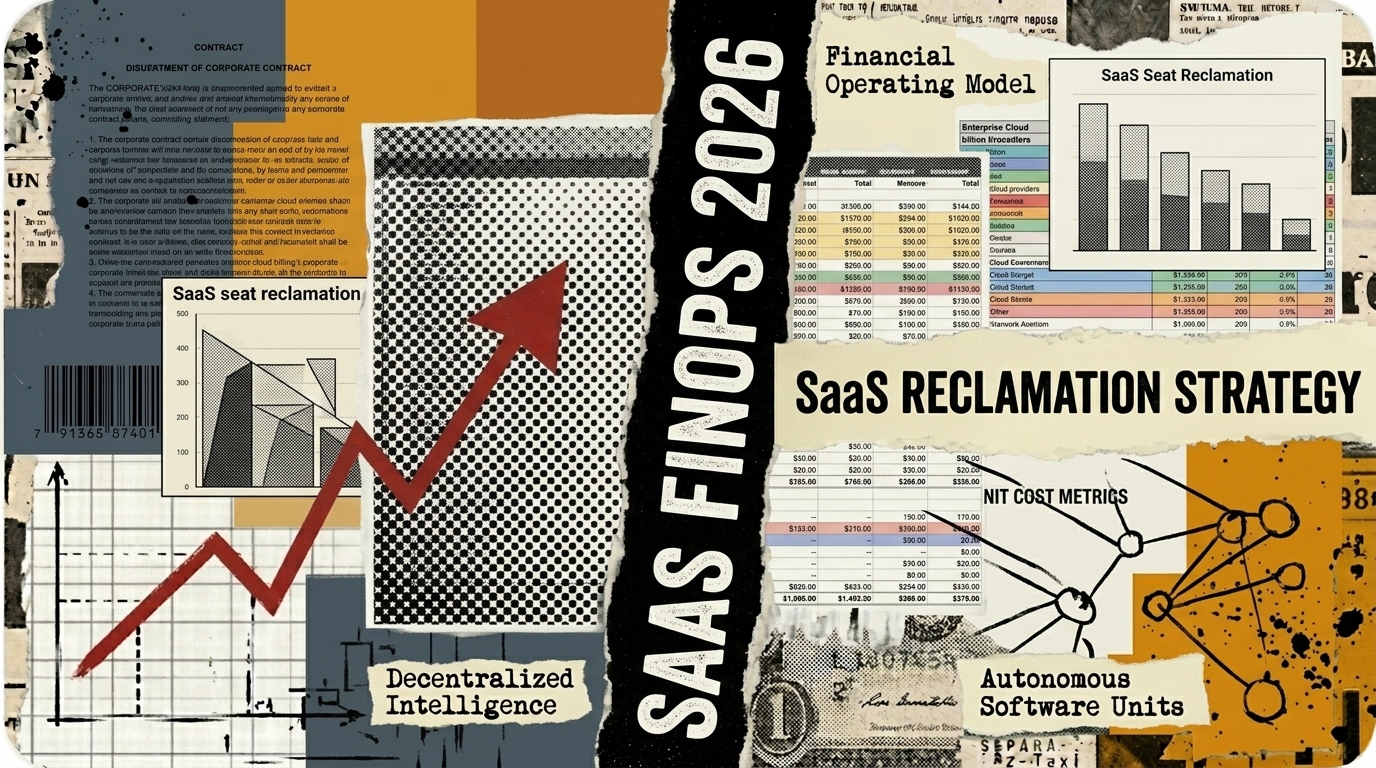
FinOps Foundation & Cost Management Blueprint How enterprise cloud teams adopt the FinOps Open Cost and Usage Specification (FOCUS 1.0) to normalize multi-cloud AI billing and prevent ELA true-up surprises. Explore our AI Budget Forecast Calculator.
FinOps for SaaS and enterprise cloud software in 2026
Enterprise License Agreement (ELA) true-up cycles.
1. Executive Summary & Market Context#
The rapid proliferation of hybrid subscription and consumption pricing models across enterprise software providers has rendered traditional annual spreadsheet audits obsolete. Modern enterprise tech stacks feature hundreds of disparate vendors, each utilizing distinct billing taxonomies, unaligned renewal cycles, and complex user activity metrics.
To eliminate multi-million-dollar billing surprises, forward-looking enterprise procurement teams are adopting the FOCUS (FinOps Open Cost and Usage Specification) standard. By normalizing billing telemetry across hyperscalers (AWS, Azure, GCP) and enterprise SaaS providers (Salesforce, Microsoft, ServiceNow), organizations establish single-pane visibility into software utilization, dormant seat allocations, and unmonitored AI token spend.
2. Strategic Cost Drivers & Financial Frameworks#
Enterprise software waste typically clusters around three primary financial failure modes:
- The ELA True-Up Freeze Trap: Vendors calculate annual contract adjustments based on peak user provisioning rather than average active utilization, resulting in permanent baseline expansion for transient staffing surges.
- AI Feature Tier Inflation: Premium AI-enabled subscription tiers carry 40% to 70% price premiums over standard licenses, yet internal usage logs reveal fewer than 18% of assigned users leverage advanced generative capabilities.
- Decentralized Shadow SaaS Sprawl: Departmental corporate credit card purchases bypass centralized procurement, fragmenting enterprise purchasing power and multiplying redundant software contracts.
To benchmark active license utilization and calculate exact reclaimable capital across your organization, use our interactive SaaS Seat Auditor and evaluate contract structures with the Pricing Model Converter.
3. Comprehensive Industry Benchmarks & Case Data#
The table below outlines license utilization and waste reclamation metrics across 250 enterprise software portfolios analyzed in 2026:
| Software Category | Average Seat Inactivity (>60 Days) | Premium AI Tier Underutilization | Average ELA True-Up Cost Surprise | Annual Reclamation Yield |
|---|---|---|---|---|
| Collaboration & Productivity | 28.4% | 58.2% | +$340,000 | 18.5% of Contract Value |
| CRM & Revenue Operations | 19.2% | 42.0% | +$620,000 | 22.1% of Contract Value |
| Enterprise ERP & Financials | 11.5% | 31.4% | +$890,000 | 14.8% of Contract Value |
| Developer & IT Infrastructure | 24.6% | 64.7% | +$410,000 | 26.3% of Contract Value |
4. Detailed Case Studies & Real-World Implementations#
Case Study#
A: Global Financial Services Enterprise (12,000 Seats) A global banking institution deployed an automated FOCUS-compliant FinOps governance framework across its Microsoft and Salesforce estates. By identifying 2,800 dormant user accounts and downgrading 1,400 inactive premium AI seats 60 days prior to annual ELA true-up, the organization prevented $2.15 million in unbudgeted annual baseline expansion.
Case Study B: Healthcare SaaS Provider (3,500 Knowledge Workers)#
A healthcare technology enterprise implemented continuous identity-provider (Okta) deprovisioning workflows. The system automatically harvested unassigned licenses after 45 days of inactivity, eliminating the need to purchase additional software seats during rapid corporate hiring cycles and saving $680,000 annually.
Case Study C: Multi-National Manufacturing Group#
A discrete manufacturing enterprise consolidated 14 redundant project management and diagramming tools onto a single enterprise agreement, leveraging aggregate seat volume to negotiate a 28% multi-year discount across 6,000 users.
5. Operational Risk, Data Governance & Security Auditing#
Software license reclamation must balance cost reduction with business continuity and information security standards:
- Reversible Deprovisioning Workflows: Enforce a 14-day soft suspension period before permanent license deletion to ensure critical project workflows are not abruptly disrupted.
- SSO Identity Hygiene: Reconcile active identity-provider directories against contractor offboarding logs weekly to eliminate orphaned credentials and mitigate data exfiltration risks.
- Compliance Audit Evidence: Maintain cryptographically timestamped records of license allocations and renewal negotiations for external SOC 2 and ISO 27001 audit verification. Review our security frameworks at Security & Data Governance.
6. Enterprise Integration Metrics & Performance Evaluation#
FinOps leaders should monitor four core quantitative metrics to evaluate technology value management maturity:
- Effective License Utilization Rate (ELUR): Active monthly users divided by total provisioned contract seats. Target benchmark: >= 85%.
- True-Up Variance Percentage: Difference between budgeted contract renewals and actual vendor invoices. Target benchmark: <= 3%.
- Reclaimed Capital Velocity: Average time required to identify and deprovision dormant software seats. Target benchmark: <= 30 days.
7. Implementation Roadmap & Vendor Negotiation Playbook#
Implement a disciplined 30-60-90 day automated license harvesting and renewal negotiation workflow:
- Day 30 (Soft Telemetry & Notification): Automatically notify users with zero authentication events over 30 days, requesting confirmation of continuing business need.
- Day 60 (Pre-Reclamation Pool Allocation): Move unconfirmed seats into a shared departmental reclamation pool to fulfill incoming employee requests without buying new licenses.
- Day 90 (Pre-Renewal True-Up Right-Sizing): Freeze enterprise license counts 90 days prior to vendor contract renewal. Use our AI Budget Forecast to model multi-quarter consumption trends and lock in volume discounts.