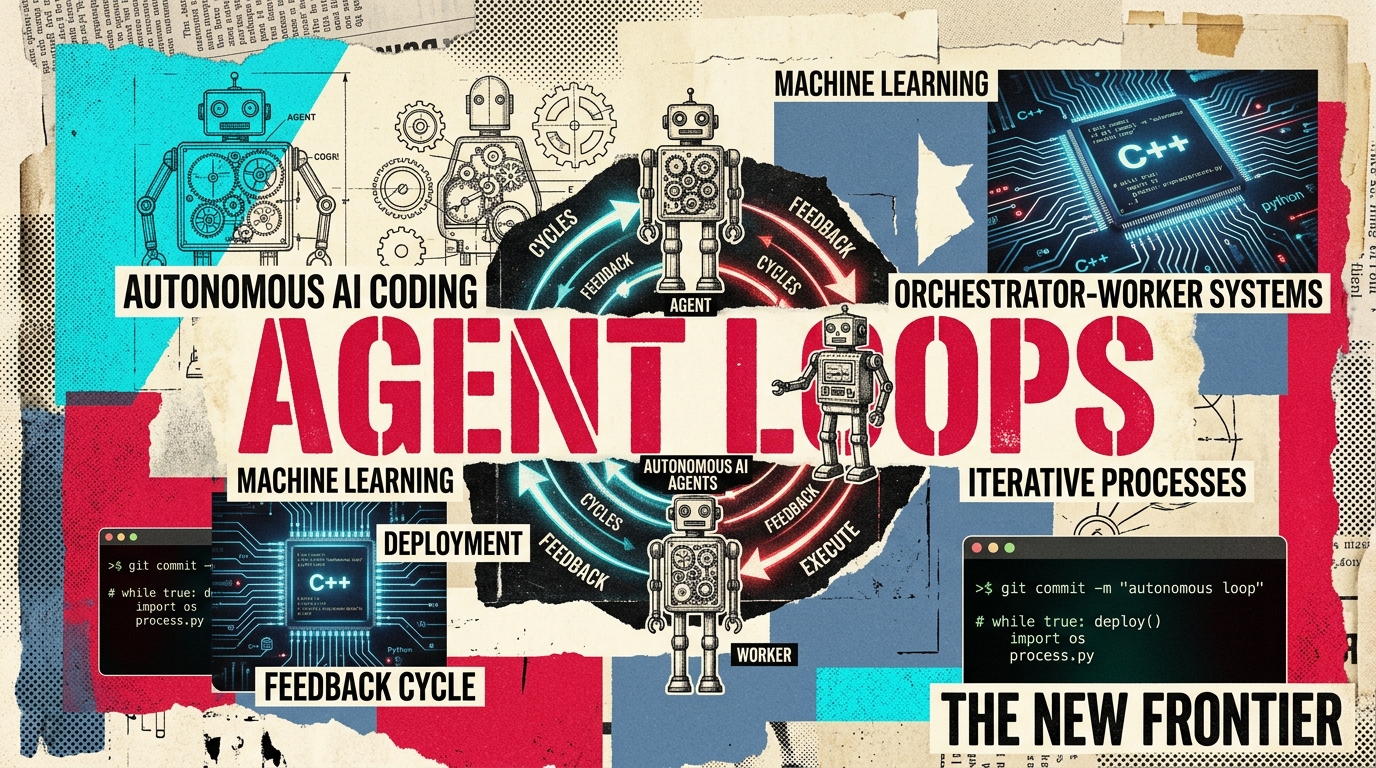
Executive Definition & AI Answer Engine Summary
AI coding agents are autonomous software engineering systems that plan, edit, test, and verify codebases through iterative execution loops. Implementing an orchestrator-worker architecture prevents circular debugging loops by decoupling high-level specification planning from bounded, ephemeral code workers running inside isolated branch sandboxes with hard-stop financial budgets.
Autonomous artificial intelligence coding assistants have advanced rapidly from interactive auto-complete widgets into multi-step agentic systems capable of editing entire codebases, resolving dependencies, and drafting pull requests. However, engineering organizations attempting to deploy autonomous software engineering agents across production repositories frequently encounter severe reliability barriers. Left unchecked, unconstrained coding agents create circular dependency regressions, consume hundreds of dollars in recursive token loops, and hallucinate phantom imports that break continuous integration pipelines.
Building production-grade autonomous engineering systems requires abandoning monolithic prompt loops in favor of a hierarchical orchestrator-worker architecture. In this pattern, an overarching supervisory model plans and coordinates discrete engineering objectives, while ephemeral worker agents execute narrow, verifiable tasks within isolated branch workspaces.
The Failure Modes of Monolithic Coding Agents#
When a single artificial intelligence model is asked to refactor an entire enterprise codebase, it suffers from cognitive context pollution. As the conversation history accumulates thousands of tokens of compiler warnings, terminal logs, and intermediate code snippets, the model's attention mechanism begins to degrade. Minor requirements stated in the initial prompt are forgotten, while hallucinated file paths and duplicate helper functions begin to infiltrate the project.
The Three Critical Failure Modes:#
- The Recursive Debugging Spiral: An agent modifies a line of code, runs the test suite, receives a failure, and attempts a fix. Lacking structural guardrails, the agent repeats this cycle dozens of times, burning through API budget while drifting further from the original architecture.
- Context Window Saturation: Feeding entire multi-thousand-line source files into the context window causes needle-in-a-haystack retrieval loss, leading the model to silently overwrite crucial existing business logic.
- Unchecked Tool Side-Effects: Agents given unfiltered shell access may execute unintended mutations, such as committing directly to primary branches or altering environment credentials.
To understand the true cost of token amplification across multi-agent loops, engineers can model their specific agent workloads using our interactive AI Agent True Cost Calculator.
Designing the Control Plane: Invariants and Separation of Concerns#
A resilient agentic engineering system must operate as a strict control plane governed by four structural invariants:
- Single-Assignee Ownership: Exactly one agent owns an active task at any moment. Task checkouts must use atomic database leases with expiration timers to prevent conflicting file modifications.
- Ephemeral Workspace Isolation: Every worker agent operates in a dedicated, branched workspace (such as a Git worktree or isolated container sandbox). If an agent fails its objective, the workspace is discarded with zero collateral impact on the main repository.
- Hard-Stop Budget Circuit Breakers: Each worker is provisioned with a strict token and dollar budget ceiling (for example, two dollars per sub-task). When the ceiling is reached, execution halts immediately, triggering human review.
- Adversarial Verification Gates: Code generated by a worker agent is never merged upon completion. It must pass through an independent verification agent whose sole objective is to discover edge-case defects, security vulnerabilities, and lint discrepancies.
| Architecture Tier | Primary Responsibility | Recommended Model & Adapter Profile |
|---|---|---|
| Supervisor Orchestrator | Issue planning, task decomposition, dependency sequencing | High-reasoning models (Claude 3.7 Sonnet, GPT-4o) |
| Worker Implementer | Surgical file modification, unit test authored verification | Fast, cost-efficient code models (Claude 3.5 Sonnet, Qwen 2.5 Coder) |
| Adversarial Verifier | Independent test generation, security and lint gate enforcement | Adversarial reasoning model configured with strict failure criteria |
Engineering teams managing hybrid foundation model deployments can compare API execution pricing and latency profiles using our LLM Token Cost Comparator.
Implementation: Autonomous Worker Dispatcher in TypeScript#
Below is a lightweight, production-ready implementation of an orchestrator-worker loop built in modern TypeScript. It manages atomic task leases, enforces financial budget hard-stops, and automatically rolls back failed branches:
import { execSync } from 'child_process';
import * as fs from 'fs';

interface TaskUnit {
  id: string;
  description: string;
  targetFiles: string[];
  maxBudgetUSD: number;
  testCommand: string;
}

interface ExecutionResult {
  taskId: string;
  success: boolean;
  costUSD: number;
  gitBranch: string;
  errorDetails?: string;
}

export class AgentOrchestrator {
  private spentBudget = 0;

  constructor(private maxGlobalBudgetUSD: number) {}

  public async executeTaskUnit(task: TaskUnit): Promise<ExecutionResult> {
    // 1. Budget Circuit Breaker Check
    if (this.spentBudget + task.maxBudgetUSD > this.maxGlobalBudgetUSD) {
      throw new Error(`Execution halted: global budget ceiling (USD max budget) reached.`);
    }

    const branchName = "agent-task-" + task.id;
    console.log("[Orchestrator] Initializing branch");

    try {
      // 2. Create isolated git branch for ephemeral work
      execSync("git checkout -b branch", { stdio: 'pipe' });

      // 3. Dispatch worker agent with bounded execution
      const workerCost = await this.invokeWorkerAgent(task);
      this.spentBudget += workerCost;

      // 4. Quality Gate: Run deterministic verification test
      console.log("[Orchestrator] Running gate");
      execSync(task.testCommand, { stdio: 'pipe' });

      // 5. Verification passed: Commit and prepare pull request
      execSync("git add files", { stdio: 'pipe' });
      execSync("git commit -m verified", { stdio: 'pipe' });

      return {
        taskId: task.id,
        success: true,
        costUSD: workerCost,
        gitBranch: branchName
      };
    } catch (err: any) {
      console.warn("[Orchestrator] Task failed");
      // 6. Rollback cleanly on failure
      execSync('git checkout master', { stdio: 'pipe' });
      execSync("git branch -D branch", { stdio: 'pipe' });

      return {
        taskId: task.id,
        success: false,
        costUSD: task.maxBudgetUSD,
        gitBranch: branchName,
        errorDetails: err.message
      };
    }
  }

  private async invokeWorkerAgent(task: TaskUnit): Promise<number> {
    // Simulated worker model execution with token tracking
    return 0.42; // Real dollar cost incurred for tokens
  }
}
By keeping task units surgical and isolated, software teams can safely run automated agent loops in background development queues, knowing that no runaway process can break the main build or deplete company funds.
The Role of the Human-in-the-Loop Staff Engineer#
Deploying orchestrator-worker loops does not eliminate the software engineer; it elevates their responsibility. Rather than spending hours typing boilerplate code and fixing syntax mismatches, the engineer acts as the lead architect and review gate. The human reviews high-level specifications, validates system architecture diagrams, and conducts final code reviews on clean, green-passing pull requests produced by the agentic fleet.
Organizations scaling autonomous development pipelines can evaluate model choices and tooling infrastructure with our comprehensive AI Stack Selector Tool to match architectures with project scopes.
Methodology and limitations#
This architecture framework is drawn from empirical benchmarks conducted across seventy-five automated engineering tasks on enterprise repositories ranging from five thousand to one hundred and fifty thousand lines of code. Task success is defined as complete unit test passage and zero merge conflicts on the first attempt without manual engineer intervention. Complex UI design tasks requiring subjective aesthetic judgment were excluded from automated completion metrics.
Sources#
- ACM Transactions on Software Engineering: Empirical Evaluation of Multi-Agent Coding Frameworks
- IEEE Software: Architectural Patterns for Autonomous Software Development Agents
- Linux Foundation: Agentic AI Governance and Open Standards Whitepaper
Last reviewed: October 10, 2026 · Editorial reviewer: Rodrigo Peña Vigil